As we approach this weekend’s Oscars ceremony, arguably the most competitive and interesting category will be for the best international feature film. One of the front runners is The Secret Agent, the latest movie by Brazilian filmmaker, Kleber Mendonça Filho.
The Secret Agent is set in 1970s Brazil, a time of “mischief” as the film puts it which turns out to mean corruption, murder, paranoia and at times just plain absurdity. All of which is depicted in Filho’s film. Wagner Moura (also nominated for his performance, having already won best Actor at Cannes for this role), stars as Marcelo, a man who is introduced to us driving a yellow Beetle and pulling up to a gas station where he encounters a dead body. He’s then approached by police officers who don’t seem too concerned with the rotting body, but would rather inspect Marcelo’s car and extort some money from him. Marcelo, unruffled, calmly exchanges some cigarettes in exchange for safe passage.
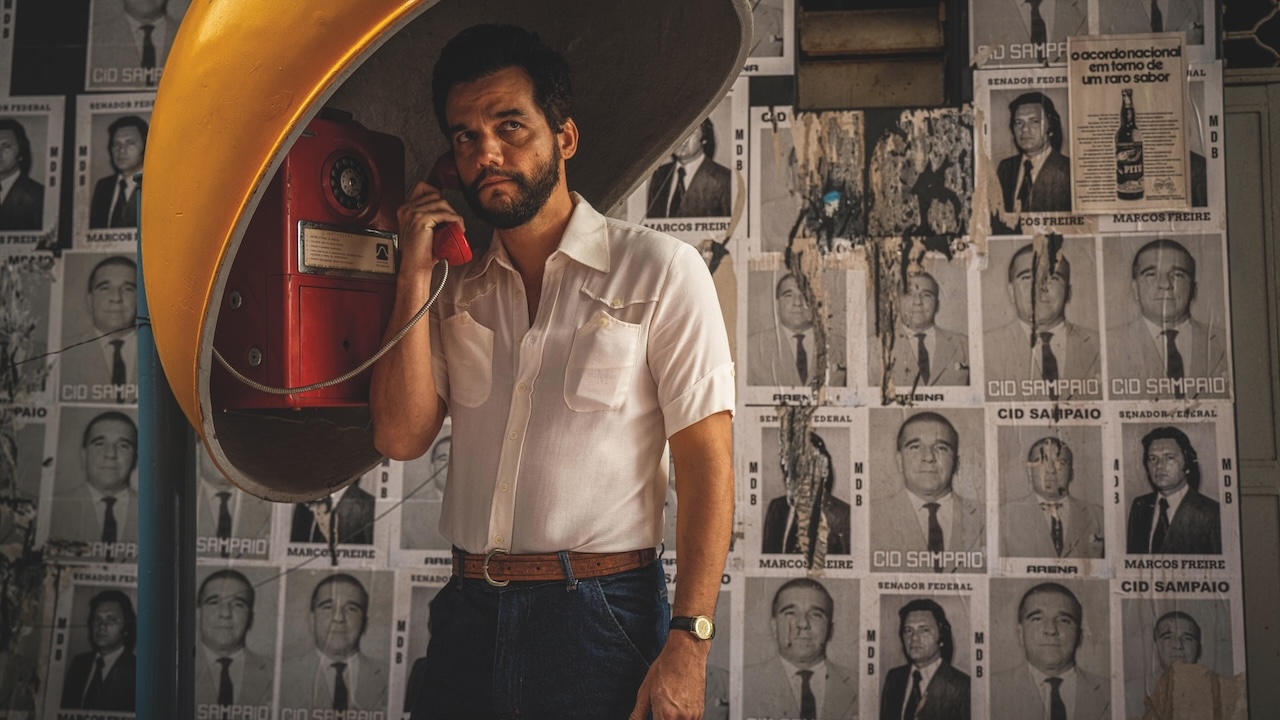
Why did they want money? Why were they not in the least interested by the corpse? Why had they followed Marcelo to the gas station? All valid questions - but don’t expect answers.
The Secret Agent isn’t a movie that will set up the stakes of the movie early on and then set the characters away on their journey. It takes its time. It asks you to engage with it and let the meaning come to you. Some may call it slow or meandering but here, in Filho’s hands, its deeply rich storytelling.
The first hour or so feels Tarantino-esque. We’re introduced to characters with little or no context, spend some time with them going about their business and then we move onto someone else. Filho has no interest in dumping exposition on us and then moving on just to please your weak attention span. We live and breathe the 1970s setting. Things are revealed over time. This is a story about the people. We will spend time with them, we’ll learn about them and they will open up to us. The result is that you can’t help but be genuinely engulfed in the world of corruption and paranoia.
Marcelo makes it to Recife, where it is revealed he has a son. We still don’t know where he’s came from or why he’s returned to Recife. He finds refuge in a shared apartment block ran by Dona Sebastiana (Tânia Maria), who houses many who seem to be running from some encroaching threat. All with their own ambiguous, troubled past, they’re a thrown together group of people who all feel like enemies in their own country. It’s a testament to the film, and indeed its actors, that each character feels deserving of their own movie. There’s so much depth in each performance that we believe in their community and even though they don’t explicitly reveal details of their past lives, they manage to communicate the weight they carry as a result of it.
Marcelo finds employment in an identity card office, where he searches for any record that his mother existed. Here, he meets the corrupt police chief played by Robério Diógenes, who seems more interested with trying to impress Marcelo than addressing the rising death toll from the city’s carnaval. Meanwhile, two hitmen are hired by a businessman to assassinate Marcelo and the hot, sweaty world around him seems to be caving in.
Wagner Moura is brilliant in this film. The world is chaotic and bustling, there’s murder and killer hairy legs and two headed cats and every character seems to have something bubbling away under the surface, but Moura is unflapped; he’s respectful. He’s the father figure for the audience, reassuring us throughout the chaos and always managing to seem like he knows what he’s doing. Even when walks out of a building into the middle of the carnival celebrations, he doesn’t seem out of place.
If it sounds like I’m omitting details from the plot, that’s because I am. I think this works best when the film reveals these details to you when it thinks you’re ready. There is another setting of sorts in the film. At first, I was unsure where we were going with it and frankly found the main setting to be a lot more interesting. But as the film proceeds, we occasionally check back into the second setting until, eventually the two collide. And then the penny dropped.
It’s not like I was sat there trying to extract some meaning from the film. In fact I was so engrossed in it that I was just enjoying my time at the cinema. But it was at this point where it all finally came together for me and I really appreciated everything that had come before. It reframed the past 2 hours or so for me. I was glad that Filho had taken the time to introduce each character and had allowed us to spend so much time with them. It encourages us to appreciate the stories of the past. The people lost to history. The mistakes we make. The loves we lost. A Two headed Cat. A severed human leg. Stories of unknown people. The many dead at the Carnival. Marcelo’s mother. Marcelo’s Wife. Marcelo himself. The past as a lesson to create a better world for the future generation.
The film doesn’t deliver itself to us on a plate. It slowly reveals itself. Everything feels like a particular choice to serve the story that is being told and its all done exceptionally well.
★★★★★
Comments
Post a Comment